
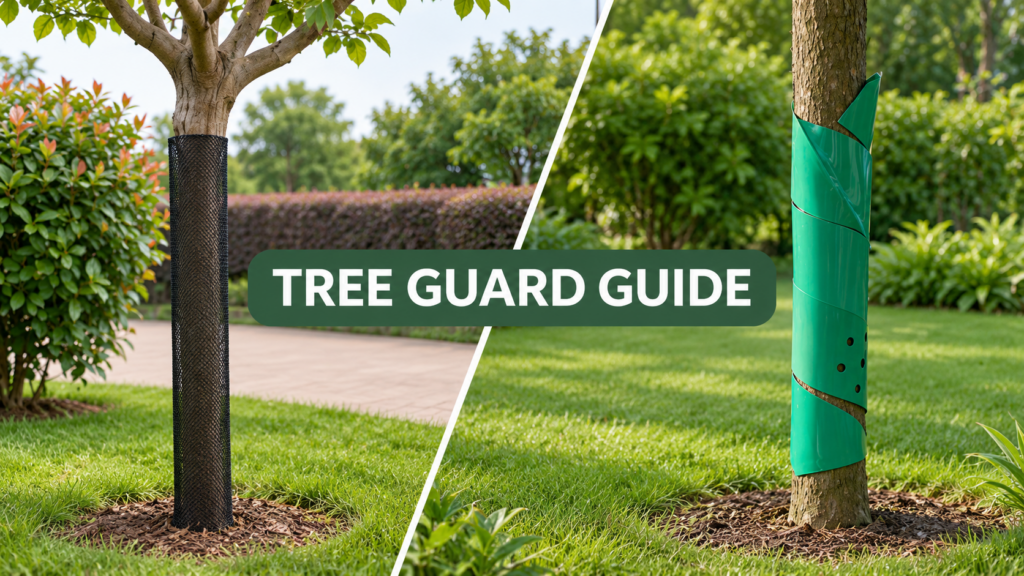
Choose a tree guard by the damage you need to prevent, not by its catalog name. Mesh offers an open barrier, spiral wraps a young stem, and corrugated designs add a more solid trunk shield. For deer or livestock, a short trunk guard may need a taller enclosure or fence.
Compare the Three Guard Designs
| Design | Useful starting point | What to verify before ordering |
|---|---|---|
| Plastic mesh guard | Projects needing an open barrier around a young stem | Mesh opening, diameter, height, stake attachment, and clearance for growth |
| Spiral guard | Young, single-stem trees exposed to small mammals | Fit at the base, expansion as the trunk grows, and removal access |
| Corrugated guard | Sites where a more continuous trunk shield is useful | Actual shape, ventilation, ground contact, fastening, and inspection access |
Match the Guard to the Actual Threat
Small mammals: protect the lower stem
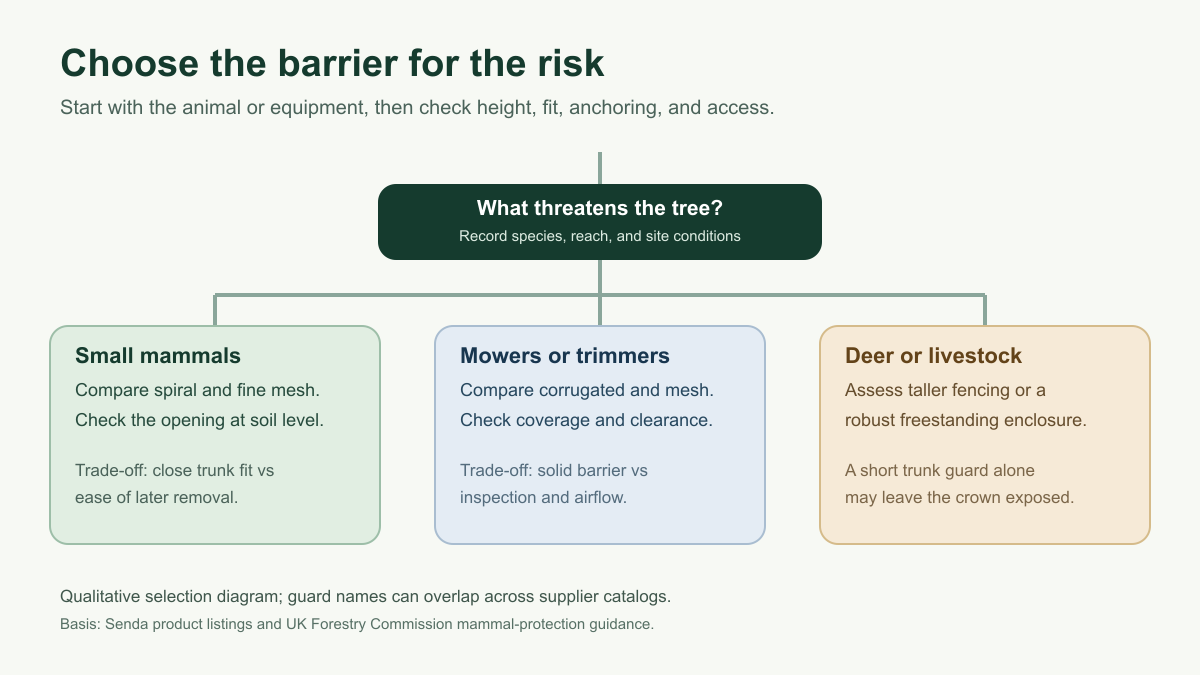
Voles, rabbits, and hares can damage young bark near the ground. Spiral guards and appropriately specified mesh are common options, but the lower edge and openings matter as much as the material.
The UK Forestry Commission says spiral guards can deter small rodents, while also warning that they can be hard to remove and may fragment. Build removal and collection into the project plan.
Maintenance equipment: shield the contact zone
Where mowers or string trimmers work close to trunks, compare a corrugated shield with a mesh design. Check which part of the stem each sample actually covers and whether crews can inspect the bark.
A solid-looking guard is not automatically the better choice. Ask how it is secured, whether it leaves space around the trunk, and how it will be opened or removed as the tree grows.
Deer and livestock: look beyond a short guard
Deer can browse above the protected trunk, and livestock can exert more force than small mammals. Specify protection around the whole vulnerable area, not just the lower bark.
Forestry Commission guidance links guard height to the target animal’s browsing reach. For demanding sites, it describes taller fencing or robust freestanding enclosures. Do not approve a short plastic trunk guard as a stand-alone deer solution without a site assessment.
Compare Size, Material, and Installation
For a bulk order, start with tree size and site conditions. The same nominal height can perform differently when a guard sits above soil, snow raises browsing reach, or branches extend beyond the barrier.
- Height: State the required protected height after installation, not only the product’s uninstalled length.
- Diameter: Check present stem size and room for growth. Confirm whether the quoted diameter is relaxed or expanded.
- Openings: For mesh, verify aperture dimensions against the smallest animal of concern.
- Fastening: Confirm the stake, ties, clips, or soil contact needed to keep the guard in place.
- Maintenance: Define inspection frequency, replacement triggers, removal method, and collection responsibility.
Material labels alone do not settle these questions. Senda’s PP mesh model SD 1096 lists 50–110 cm lengths and two mesh sizes: 2 × 2 mm and 3.5 × 3.5 mm. Confirm the selected variant on the quotation.
Its PVC spiral model SD 1092-4CM lists a 60–100 cm length range. The same page uses “corflute” in its title, which is why a physical sample is more reliable than the category name.
Build a Useful Bulk-Order Comparison
Compare delivered protection, not unit price alone. A project using thousands of guards also pays for stakes, installation, field checks, replacements, and end-of-use collection.
| Question for the supplier | Why it changes the decision |
|---|---|
| Which exact dimensions and material are quoted? | Catalog ranges may contain several variants. |
| What fixings are included? | Missing stakes or ties change the installed cost. |
| How is each guard packed? | Bulk and retail packs need different handling plans. |
| Can we inspect an assembled sample? | Fit, closure, and removal are easier to judge in person. |
| Who removes and collects used guards? | Plastic left in the field can fragment over time. |
For a mixed planting project, split the order by risk zone. You may need one specification for exposed young stems and another for equipment-prone landscaped areas. This is more useful than forcing every tree into one SKU.
Approve the Sample on Site
Install each candidate guard on representative trees before approving production. Use the same stakes and tools your crew will use at scale, then record what happens during installation and the first inspection.
- Check the guard against the actual stem diameter and branching pattern.
- Measure installed height and look for gaps at ground level.
- Test the fastening without pressing hard edges into the bark.
- Confirm that you can inspect, loosen, and remove it later.
- Photograph the approved setup and attach it to the purchase specification.
These checks turn a vague request for “tree guards” into a repeatable acceptance standard. They also expose differences between a product’s catalog dimensions and its fit in the field.
FAQs about Mesh, Spiral, and Corrugated Tree Guards
Are mesh guards always better ventilated?
Open mesh generally leaves more of the stem exposed to moving air. Still, compare the actual sample: opening size, guard diameter, and nearby vegetation affect the conditions around the bark.
Can a spiral guard protect a tree from deer?
A short spiral mainly covers the stem. Deer may reach foliage and branches above it. Assess a taller enclosure or fence when deer browsing is the main risk.
Is a corrugated guard a separate type from a spiral guard?
Not always. “Corrugated” describes a fluted structure, while “spiral” describes how a guard wraps or opens. A supplier may use both terms for one product, so request photos and a sample.
When should plastic tree guards be removed?
Remove them when protection is no longer needed or when they restrict growth or deteriorate. Check local project guidance and arrange collection rather than leaving plastic to break apart on site.
Discuss Your Tree Guard Specification With Us
We manufacture plastic gardening accessories, including mesh and spiral tree guards. Share your planting conditions, required dimensions, quantity, and packing needs so we can help identify a suitable option.
Explore our tree guard range, then contact us with your project brief and sample requirements.