
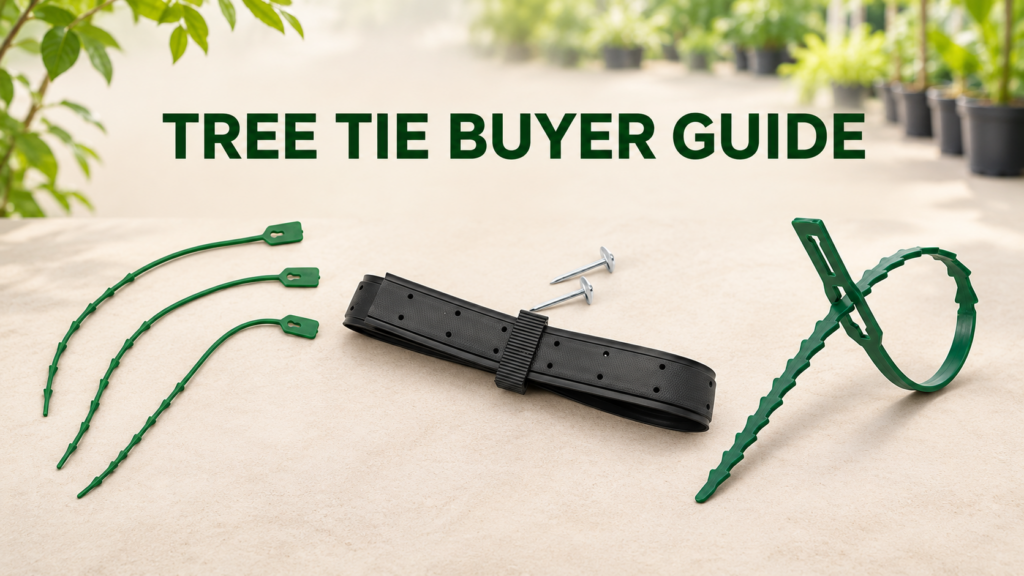
For nursery and landscape orders, choose the finished tie by its size, trunk contact, fastening, and pack format. The material name alone does not tell you whether a tie fits your tree or staking method.
PVC vs TPR vs PE: At a Glance
| Material and Senda example | Listed size | Format to evaluate | First sample check |
|---|---|---|---|
| PVC SD 1035-PVC | 35 × 1.6 cm | Compact strip; bag or head-card pack | Fit around the specified trunk and stake |
| TPR SD 1060 | 90 × 3.8 cm | Long, broad strap | Contact area, fastening, and trunk movement |
| PE SD 1035 | 35 × 1.2 cm | Compact adjustable tie; head-card pack | Closure security and ease of readjustment |
What the Three Formats Change in Practice
PVC: compact strip and pack flexibility
- Consider it for: A defined tie point and a compact pack. The listed model is 35 × 1.6 cm, with bag and head-card options.
- Check on a tree: Does it reach around the trunk and stake without being pulled tight? Inspect the edge and fastening after installation.
- Check for the order: Compare pack count and shelf presentation for retail, or ties needed per tree for a project.
TPR: longer strap and broader contact
- Consider it for: A stake layout that needs more length or contact area. The listed model is 90 × 3.8 cm.
- Check on a tree: Does the strap stay in place without rubbing bark or restricting appropriate movement? Test the fastening and loop size.
- Check for the order: Specify the exact model. “TPR” alone does not identify its dimensions or fastening.
PE: adjustable closure in a compact format
- Consider it for: A compact tie that crews may need to reposition. The listed model is 35 × 1.2 cm.
- Check on a tree: Loosen and secure the same sample with the gloves crews use. Look for slipping, closure damage, and loop clearance.
- Check for the order: Confirm pack quantity and stem size. Do not assume it replaces a broad strap in a different staking setup.
Which Tie Fits Your Project?
Shortlist by the actual staking layout:
- Compact tie point: Start with the PVC strip and verify installed length and bark contact.
- Longer reach or wider contact: Start with the TPR strap and verify fastening and movement.
- Frequent readjustment: Trial the PE closure and check whether it stays secure after refastening.
- Retail assortment: Compare the available PVC and PE packs by pieces per pack, labeling, and carton quantity.
The Royal Horticultural Society recommends allowing some trunk movement and checking ties as trees grow. Test each tie with the actual stake and any required spacer. Neither a wider strap nor a resin label proves bark safety by itself.
Five Checks Before a Bulk Order
| Check | What to record |
|---|---|
| 1. Application | Trunk diameter, stake layout, exposure, and expected support period |
| 2. Trunk contact | Width, edge finish, rubbing, clearance, and movement after installation |
| 3. Fastening | Installation time, slip, and ability to loosen or remove the tie |
| 4. Outdoor requirements | Any required UV, tensile, or service-life test method and result for the finished SKU |
| 5. Commercial details | Exact model, color, pieces per pack, carton count, order unit, MOQ, and lead time |
Trial samples on representative trees with the crew that will install them. Record the result for each model and retain the approved sample. Confirm whether a quotation’s “piece” or “set” refers to one tie or a packed unit before comparing prices.
A Simple Sample Trial
- Install: Fit each sample to a representative trunk and stake. Record handling time and whether the tie sits without excessive tension.
- Inspect: Check bark contact, stake clearance, and movement. Use a spacer where the staking method calls for one.
- Adjust: Loosen and refasten the tie. Look for slip or damage at the closure.
- Recheck: Inspect after the agreed outdoor trial period. Record changes in fit and fastening.
- Approve: Retain the selected tie and pack as the reference for future deliveries.
Set acceptance criteria before comparing prices. If your contract specifies UV resistance, tensile strength, or service life, request a test method and results for the finished SKU. Include regular checks and eventual tie removal in the aftercare plan.
FAQs about PVC, TPR, and PE Tree Ties
Is TPR always better for bark than PVC or PE?
No. Check the finished tie’s width, edges, tension, and movement on the intended tree. Material alone does not establish bark safety.
Can a PE adjustable tie replace a broad TPR strap?
Only if the installed sample meets the same project requirements. These example models differ substantially in length and width.
How often should ties be checked?
Inspect them regularly and after severe weather. Loosen or remove ties that rub or become tight as trunks grow, following your project’s aftercare plan.
Request Samples for Your Specification
Send Senda your tree size, stake layout, preferred pack, and order quantity. Review the tree tie range and request samples or a quote.