
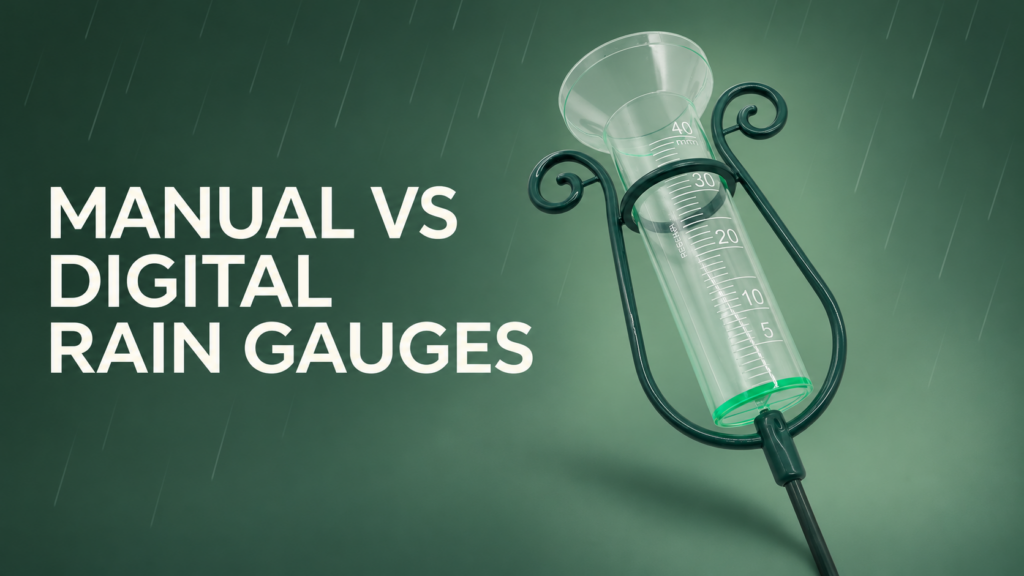
Choose a manual rain gauge when customers need a visible rainfall total and can read it on site. Choose a digital model when they need automatic records. Neither type is accurate by default: placement, reading, cleaning, and calibration still matter.
Manual vs Digital Rain Gauges at a Glance
| Buying question | Manual gauge | Digital gauge |
|---|---|---|
| How is rainfall recorded? | A person reads the collected water and empties the gauge | A sensor records readings automatically; many use a tipping bucket |
| What data is available? | Accumulation since the last emptying | Time-stamped totals and, depending on the model, rainfall rate or history |
| What does it depend on? | A readable scale and a regular observer | Power, sensor operation, and a working display or logger |
| What needs attention? | Reading, emptying, cleaning, and checking the scale | Cleaning the collector, checking level, power, connectivity, and calibration |
| Where does it fit? | Garden retail, basic site checks, and manual reference readings | Unattended logging, weather stations, and programs needing time series |
The Australian Bureau of Meteorology describes manual collection and automatic tipping-bucket measurement. Its explanation shows why the two formats answer different reporting needs.
When a Manual Gauge Is the Better Fit
A manual gauge gives the user a direct view of collected rain. It works well when a gardener, grounds crew, or nursery worker already visits the site and can record a reading after each event.
It is also easy to explain at retail: install the gauge, read the level, write down the total, and empty it. The printed scale and included holder matter more than an app or display.
- For garden retail: Check whether the scale is legible at the intended viewing angle and whether the pack includes the mounting parts shown on the shelf.
- For grounds maintenance: Assign someone to read and empty it at a consistent time. A missed visit combines rainfall from more than one period.
- For a digital-system check: A nearby manual gauge can provide an independent total to compare after a storm, provided both are properly sited.
Cornell’s NEWA guidance recommends comparing an automated gauge with a manual one. The manual reading still depends on the observer’s care and the gauge’s construction.
When Digital Is Worth the Extra System
Digital rain gauges suit customers who need measurements while no one is present. A connected weather station can record totals across days and capture the timing of rainfall, subject to its logging setup.
Many automatic gauges use a tipping bucket: collected water tips a calibrated mechanism, and the system counts pulses. The display is digital, but the collection and moving parts remain physical.
- Ask what the customer needs: A current total, rainfall rate, daily history, alerts, or data export? These are different product requirements.
- Specify the whole system: Confirm sensor, display or logger, power source, transmission range, and any subscription before comparing quotes.
- Plan maintenance: Debris can block the funnel; a gauge that is not level or calibrated may record a misleading total.
Automatic does not mean maintenance-free. University of Florida guidance calls for regular rain-gauge inspection, including keeping the funnel clean and the unit level.
Accuracy Depends on the Instrument and the Site
A digital display with more decimal places is not proof of a more accurate measurement. Look for a stated resolution, a test method, and results for the exact model you plan to buy.
For manual gauges, inspect the collector opening, graduation spacing, printed units, maximum reading, and overflow arrangement. Read a sample with water in it, not only through product photos.
For tipping-bucket gauges, ask how calibration is checked across the expected rain rates. The US National Weather Service notes that light rain and intense rain can introduce different tipping-bucket errors.
Both types need a level opening and a suitable location. Trees, buildings, irrigation spray, and wind can distort the catch. Move neither gauge just to obtain a more convenient reading.
What Senda’s Manual Range Offers
We list manual plastic rain gauges, not a digital sensor or wireless station, in our current rain-gauge category. Buyers can choose among several physical formats and confirm the printed scale for the selected SKU.
- SD 1051: A 17 cm cup with a 77 cm metal support. Check stake assembly and visibility after installation.
- SD 1052: A 24.3 cm cup with a separate holder. Confirm the mount and the viewing angle for your market.
Choose by the Customer’s Workflow
- Define the decision: Does the customer need one readable total, or a time-stamped record without a person on site?
- Define the reporting unit: Specify inches, millimeters, or both. Keep the printed scale and instructions consistent.
- Check installation: Compare the proposed location, mounting parts, level position, and access for cleaning.
- Test a sample: Read the manual model with water in it, or check a digital model’s sensor and data log against a known reference.
- Quote complete sets: Include holder or stake, packaging, spare parts if applicable, order unit, and after-sales responsibilities.
If your customer wants automated irrigation control, verify that requirement separately. A rain gauge measures precipitation; it does not necessarily switch an irrigation system off. The required controller compatibility should be specified in the RFQ.
FAQs about Manual and Digital Rain Gauges
Is a digital rain gauge always more accurate?
No. Accuracy depends on the collector, calibration, siting, and maintenance. A digital readout can be precise-looking while the sensor is clogged or out of level.
Can a manual gauge show when rain fell?
It shows accumulation since its last reading and emptying. To know when rain fell during that period, you need observations or a recording instrument.
Should buyers use both types?
Sometimes. A manual gauge can provide a useful comparison for a digital station, especially after a suspicious reading. Install them in similarly exposed positions and compare the same time interval.
Request a Manual Rain Gauge Sample
We manufacture plastic gardening accessories, including several manual rain-gauge formats. Explore our rain-gauge range and contact us with your target market, scale, mounting, packaging, and order quantity. We can confirm a suitable sample and current specifications.